Sunday, August 2, 2009

Black Eyed Peas: Let's Do This!


Thank goodness for amazingly profitable companies that establish foundations for the promotion of the arts in inner cities and partner with the foundations of amazingly profitable music artists and orchestrate summits for teens all over the world that end with performances by said music artists. Because sitting right in front of me at Adobe Youth Voices Live in San Francisco tonight were the Black Eyed Peas.

The Peas, who really were literally sitting two feet in front of me, got up to perform “Imma Be” from their newest album “The E.N.D.” with a youth dance group comprised of teens from Imani’s Dream Dance Troupe, the Boys and Girls Clubs of the Peninsula, and Mt. Pleasant High School in San Jose.

Fergie wore a black romper with what looked like 6-or-7-inch black and red peep-toe heels. They did seem to somewhat inhibit her dancing ability, but she stepped around rather gracefully. Apl.de.ap was in jeans and sneakers, which allowed him to perform several backflips onstage, while Taboo rocked a pair of white skinny jeans and a leather jacket, his hair pulled tightly back.

The event was the culmination of the three-day first-ever global Adobe Youth Voices Live summit that did indeed bring youth together from as far as Uganda, New Zealand, Jordan, and the UK to learn new media skills and share their own stories through the videos they brought with them.

Adobe Youth Voices partnered with the Black Eyed Peas’ Peapod Foundation to open “two new state-of-the-art music and multimedia academies for youth in Oakland and Redwood City, Calif.” Read the entire press release HERE.

Shantanu Narayen, president of Adobe, thanked the Peas for their partnership and enthusiasm. He also apologized for will.i.am’s absence (“He’s sick,” apl.de.ap said with a mock pout).

Fergie, who sounded surprisingly normal and down-to-earth, said she was “so excited and so proud of all this new talent that I see and I can’t wait to hear the success stories coming out of these new academies.”

She, like all of her fellow Peas, thanked Adobe profusely. “Thanks to all of you. There’s a lot of creative talent in this room,” she said, prompting huge applause from the audience.

Taboo started in Spanish, “I’m here to represent all of the Latinos from LA,” to enormous cheers. “We are so excited about the tools that we’ll be bringing to the kids – no, I don’t want to say kids, because they’re more than just kids. They’re our people.”

Taboo’s eloquence and erudition were really quite extraordinary. He clearly has a way with words – and people.

“So with that I say Let’s Do This. When you go home tonight and think about the kids putting it down, my troop putting it down, you say Let’s Do This. When you look at another person who’s showing their dreams in their career you say Let’s Do This. When you see Adobe and Black Eyed Peas partnering up you say Let’s Do This. So on the count of three I need everybody to say Let’s Do This. ONE, TWO, THREE!”

“LET’S DO THIS!!!”

There was a lot of love in that room, and we all had a feeling it was going to be a good night.

And it was.

Thursday, July 16, 2009

Legal Brief: Sotomayor Hearing Day 4

The following exchange between Judge Sotomayor and our good friend Senator Lindsey Graham, R-SC, serves to summarize today's hearing:

GRAHAM: You have, I think, consistently, as an advocate, took a point of view that was left of center. You have, as a judge, been generally in the mainstream.  

The Ricci case, you missed one of the biggest issues in the country or you took a pass. I don't know what it is. But I am going to say this, that, as Senator Feinstein said, you have come a long way. You have worked very hard. You have earned the respect of Ken Starr. And I would like to put his statement in the record.

And you have said some things that just bugged the hell out of me.

The last question on the "wise Latina woman" comment. To those who may be bothered by that, what do you say?

SOTOMAYOR: I regret that I have offended some people. I believe that my life demonstrates that that was not my intent to leave the impression that some have taken from my words.

GRAHAM: You know what, Judge? I agree with you. Good luck.

––––––––––––––––––––––––––––––––––––

The Huffington Post did a remarkable summary, including video, of the best moments of today's hearing, and I don't wish to reinvent a superb blog entry.

Read it HERE.

Full transcript of the hearings HERE.

Live video of hearings HERE.

Tuesday, July 14, 2009

Judging the Judge: Day 2 of the Sotomayor Hearings


Hearings for the Supreme Court Nominee Sonia Sotomayor continued today, with senators beginning the meat-and-potatoes of the hearings: questions.

Senator Patrick Leahy, D-VT, Chair of the Judiciary Committee, started the proceedings with a question about the Second Amendment, a topic on which Sotomayor continued to field questions throughout the day. "I've owned firearms since my early teen years," Leahy said. "I suspect a large majority of Vermonters do. I enjoy target shooting on a very regular basis at our home in Vermont." He asked about the distinction regarding whether Second Amendment rights are "fundamental" or "personal" (apparently, there's a difference) but overall got through his questions without incident.

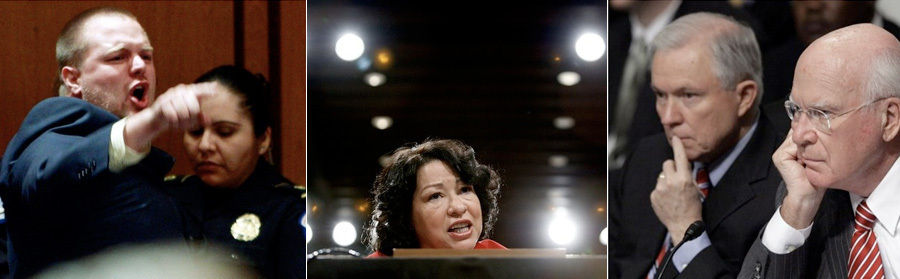
All the Republican senators continued to attempt to paint Sotomayor as an activist judge who made rulings based upon her personal biases. Senator Jeff Sessions, R-AL, got in some trouble with his aggressive questioning, but Senator Jon Kyl, R-AZ, seemed to really get to the heart of all the allegations against the Judge and for the first time, Sotomayor responded directly to the "wise Latina" comment. 

"The words I chose, taking the rhetorical flourish, it was a bad idea," she said. " I do understand that there are some who have read this differently, and I understand why they might have concern.

"But I have repeated -- more than once -- and I will repeat throughout, if you look at my history on the bench, you will know that I do not believe that any ethnic, gender or race group has an advantage in sound judging. You noted that my speech actually said that. And I also believe that every person, regardless of their background and life experiences, can be good and wise judges."

Kyl respectfully accepted this.

But Senator Orrin Hatch wins the Most Awkward Questioning award. He, like many of his other colleagues, decided to talk about the second amendment, and got into a very detailed discussion with Sotomayor regarding Maloney v. Cuomo:

HATCH: As a result of this very permissive legal standard -- and it is permissive -- doesn't your decision in Maloney mean that virtually any state or local weapons ban would be permissible?

SOTOMAYOR: Sir, in Maloney, we were talking about nunchuk sticks.

HATCH: I understand.

SOTOMAYOR: Those are martial arts sticks.

HATCH: Two sticks bound together by rawhide or some sort of a...

SOTOMAYOR: Exactly. And -- and when the sticks are swung, which is what you do with them, if there's anybody near you, you're going to be seriously injured, because that swinging mechanism can break arms, it can bust someone's skull –

HATCH: Sure.

He finished it off with, "I want you to know I've appreciated this little time we've had together."

And yet, even Hatch's nunchuks could not compare to Senator Grassley's reaction when a protester began shouting during one of Sotomayor's reponses to Grassley's questions.

Senator Leahy, Chair of the Judiciary Committee, banged his gavel right away and said, "Officer, remove that man immediately. We will stand in order – Officers, you will remove that man!" (The officers removed the man.)

Leahy joined in the audience's laughter. He reiterated his mantra of respect and order in the court, then turned to Senator Grassley again. "Senator Grassley, we did stop the clock, so it did not take away from your time."

Grassley responded, "Thank you. People always say I have the ability to turn people on."

Understandably, it took a couple minutes for the giggles over that one to die down, and even Sotomayor, wiping the tears from her eyes, said, laughing, "I hope I remember where we were."

Despite momentary lapses in etiquette, general tranquility, and (in some cases) sanity, there seemed to be a camaraderie forming between Sotomayor and the senators, even those who will likely vote against her. The relative civility in what could be a terribly chaotic process of choosing a Supreme Court Justice, involving all three branches of government, speaks well of our legislative and judicial system. We may not all agree that citizens should be allowed to swing numchuks around the Washington D.C. greater metropolitan area, but at least we're not in Iran.

Read the full transcript HERE. Watch the hearings live if you can wake up at 6:30am Pacific Time.

Monday, July 13, 2009

Who Wants to Be a Supreme Court Justice? Part I

Judge Sonia Sotomayor, President Obama's nominee to replace Justice David Souter on the United States Supreme Court, today endured the first of what will be many days of confirmation hearings before the Senate Judiciary Committee. [This is the lady who, if confirmed, will have the power to make decisions on such sizzling issues as abortion, stem-cell research, and perhaps even gay marriage.]

Each Senator on the committee made an opening statement, with Senator Patrick Leahy, D-VT, presiding over an assembly of 19 lawmakers. These included our very own Dianne Feinstein, D-CA, Arlen Specter, Republican-turned-Democrat-because-his-reelection-chances-were-higher-PA, and Al Franken, D-MN, who drew some appreciative laughter with his remark, "As most of you know, this is my fifth day in office."

Sotomayor's now-famous "wise Latina" remark  got an indecent amount of airtime, mostly in opening statements from Republicans, almost all of whom voiced "concerns" with Sotomayor's comments which suggest a bias towards certain groups. Some GOP senators even criticized President Obama for his advocacy on behalf of "judicial empathy." However, Lindsey Graham, R-SC, said in his opening statement, "Unless you have a complete meltdown, you are going to be confirmed."

Graham's opening statement was, in my opinion, rather garbled and certainly heavy in folksy language. He started off on the right foot with "No Republican would have chosen you, Judge; that's just the way it is." He proceeded to reference conservative Judge Miguel Estrada, a Honduran immigrant whom George W. Bush nominated to the D.C. Circuit Court of Appeals in 2001. Graham seemed to be trying to make the point that because there exist both conservative and liberal Hispanic justices, Judge Sotomayor's ethnicity is not the issue at hand; rather, it is a question of Republican vs. Democratic ideals, but managed to pour out a stream of vaguely ethnically insensitive phrases.

Judge Sotomayor also made a brief opening statement. In the face of so many allegations concerning her impartiality and bias, she stated, "In the past month, many Senators have asked me about my judicial philosophy.  It is simple: fidelity to the law."

Much much more will come on this topic as hearings continue and this blog will include updates and summaries throughout the week. Watch the hearings live on C-SPAN.

Friday, June 26, 2009

On Sleeping Late

I love going to bed late. Unfortunately, I hate waking up late. Therefore, I am perfectly suited to a job as a CEO of a very small startup company, Barack Obama, or a sanitation worker (read: garbageman) who also works the late shift as a bartender.


My aversion to awakening when the sun is already halfway across the sky may not be shared by many of my fellow high school students, who may prefer to raise their head from a pillow just before dinnertime or, indeed, not at all.


Waking up late and feeling good about it requires a confidence that nothing worthwhile ever goes on while you’re not conscious and able to participate. Be it an important email you’re expecting, your family’s spontaneous decision to go to Six Flags without you, or even just breakfast, there is always the anxiety of missing something by sleeping in.


On the other hand, sleeping in is the main attraction of summer, and, based on a voluntary poll, most of my peers are either able to overcome the fear of missing some vital morning event or just don’t really care what happens while they’re unconscious.


In summer, on average, Paly students hit the sack at 10:54pm. During the school year, the average bedtime is 11:24pm. This serves to dispel the myth that, when given the chance, teenagers stay up until all hours of the night behaving dangerously. (Well, I can’t vouch for that last part, but still.)


Students wake up around 9:30am in the summer but 6:48am during the year. This means that the majority of the discrepancy between total hours of sleep in summer and during the year is based upon wake-up time, not bedtime.


Given freedom, the majority of students sampled would go to sleep earlier than they do during school and wake up later. Later start times for school would not, contrary to popular opinion, encourage late night parties, or somehow let the kids know that the administration is “giving in” to their reckless teenage lifestyle. We wouldn’t party; we’d sleep.


During the year, the average Paly student gets seven hours of sleep. During the summer, he or she gets ELEVEN.


And it helps, too. “I can feel myself being way less tired in the morning,” said a junior girl. A sophomore confirmed, “It feels weird because during the school year I'm always having to keep myself awake during class and it distracts me, but now [in summer] I don't feel tired and everything I do feels so focused.”


Some Paly students also share my own affinity for waking early. “I wish I could sleep until noon but then I feel like I wasted my day,” said a junior girl. A junior boy said “I really like waking early because nobody is awake, it's dark, and I can get things done.”


The National Institute of Health says teenagers need nine or more hours of sleep. So do like the nice Surgeon General tells you and just sit back, relax, and take a nap.

Thursday, May 28, 2009

21st Century Skills: The Movement

This short video is part of a research project about 21st century learning for Congresswoman Anna Eshoo's Student Advisory Board. A copy is currently en route to the White House.


Friday, May 22, 2009

Obama Cabinet Member Speaks - and Listens - in San Francisco

With "listening tours" replacing "speaking engagements" as the most sophisticated method of gaining recognition and popularity, US Secretary of Education Arne Duncan is keeping in vogue.


Duncan, who stands around 6ft 5, gave a brief speech and answered student questions at the San Francisco School Alliance Luncheon at the San Francisco Palace Hotel on Friday.


Our new educator-in chief has an competent and reassuring aura, although his rhetoric lacks the inspirational quality that brings crowds to their feet cheering. He spoke apparently extemporaneously in his address to the assembled educator and his answers to students’ questions.


Duncan, who played professional basketball in Australia after finishing his American education, spoke sternly about the state of the California educational system. “I ask you, is California going to lead the race to the top or are you going to lead the retreat?” he said.


The recent failure of budget measures designed to bail California out of the state budget crisis will mean deep cuts and layoffs for education. In fact, according to an informational video at the luncheon, California ranks #1 in the nation in prison spending and #49 in public school spending.


“Rahm Emanuel has a great quote: ‘Never waste a good crisis,’ ” Duncan said. “California must use this crisis to drive the kind of change we need.”


The secretary ticked off some of the major challenges facing the California education system, including the achievement gap, dropout rates, and dumbed-down standards.


“Too many states are lying to children,” he said, emphasizing that fulfillment of the current “standards” is not an indication of true readiness for higher education. However, Duncan warned against simply adding more standards to the list. “Higher standards doesn’t mean more standards,” he said. “Fewer, higher, clearer standards, I think, make a lot of sense.”


Duncan also took the opportunity to offer his opinion on reform of No Child Left Behind, the Bush-era education policy that made public school funding dependent upon test scores. He said NCLB was sometimes too quick to label schools as failures: “It’s demoralizing, and it’s wrong.”


The secretary endeavored to end his remarks on an inspirational note. “We’ve lacked the political courage and will to do right by our children,” he said. “I challenge you all to find that courage and political will.”


Duncan fielded questions from San Francisco high school students about financial aid, SAT preparation, AP classes, and undocumented immigrant students. He answered most of them quite thoroughly. “I have two questions, but they’re quick,” one student said. “First: Who wins the pickup games - President Obama or you?” Duncan replied, “What’s the second question?”


San Francisco Superintendent Carlos Garcia also made remarks at the luncheon. A fiery and dynamic speaker with a passion for social justice, Garcia, when talking about the achievement gap, went so far as to say that the school system “unfortunately has some elements of institutional racism.” He recalled how because he started school speaking only Spanish, he was placed in classes for mentally and developmentally disabled students.


“Acceptance of the achievement gap is unacceptable,” he said. “It’s time to shut up and start doing.”